Comparison
Krill Oil vs Fish Oil: What the Labels and the Studies Show
Krill oil vs fish oil compared on real labels: EPA and DHA per softgel, phospholipids and astaxanthin, what absorption studies found, and who funded them.
Affiliate links. Some links on this page are affiliate links: if you buy through them, Nourlume may earn a commission at no extra cost to you. Affiliate relationships do not determine our editorial conclusions. About affiliate links
In this article (6)
Krill oil is sold as a more modern alternative to fish oil: a different form of omega-3, a red antioxidant pigment and smaller doses that supposedly work as well. Both oils supply the same two long-chain omega-3s, EPA and DHA. This comparison puts three krill oils sold on iHerb next to the fish oils we’ve already compared, and sets out what the absorption studies found and who paid for them.
The krill oils in this comparison
 Most EPA + DHA of these threeCalifornia Gold Nutrition Premium Krill Oil with Superba BoostEPA + DHA per serving: 220 mg (EPA 150 mg, DHA 70 mg)
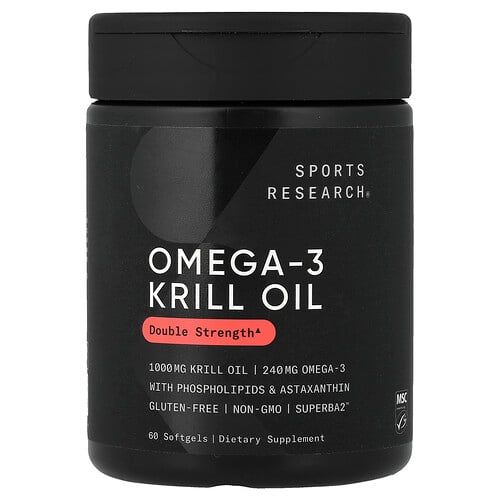 Superba2, choline listedSports Research Omega-3 Krill Oil 1,000 mgEPA + DHA per serving: 196 mg (EPA 136 mg, DHA 60 mg)
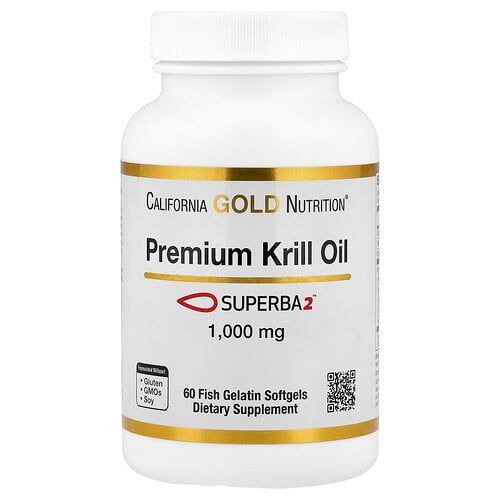 iHerb’s own brand, Superba2California Gold Nutrition Premium Krill Oil with Superba2EPA + DHA per serving: 175 mg (EPA 120 mg, DHA 55 mg)
Affiliate links. Details, strengths and limitations for each product are below.
What’s different about krill oil
Krill are small crustaceans, and the oil made from them differs from fish oil in three ways that matter on a label:
- The form of the omega-3s. Fish oil carries EPA and DHA mainly as triglycerides. Krill oil carries them partly as phospholipids, the fats that make up cell membranes, along with di- and triglycerides and free fatty acids. One analysis of a krill oil supplement found about a fifth of its EPA and DHA as free fatty acids.
- Astaxanthin. Krill oil contains astaxanthin, the pigment that gives it its red colour. The labels we checked list 85–100 mcg per softgel.
- Less EPA and DHA per gram of oil. This is the difference you can see on the Supplement Facts panel, and the next section shows how large it is.
The labels side by side
All three krill oils provide 1,000 mg of krill oil per softgel and one softgel per serving. Two use the same branded ingredient, Superba2; California Gold Nutrition also sells a more concentrated version, Superba Boost.
| Product | | | |
|---|---|---|---|
| EPA + DHA per serving | 220 mg (EPA 150 mg, DHA 70 mg) | 196 mg (EPA 136 mg, DHA 60 mg) | 175 mg (EPA 120 mg, DHA 55 mg) |
| Total omega-3 per serving | 270 mg | 240 mg | 220 mg |
| Phospholipids per serving | 560 mg | 400 mg | 400 mg |
| Astaxanthin per serving | 85 mcg | 100 mcg | 100 mcg |
| Shell and additives | Fish gelatin (tilapia), purified water, vegetable glycerin, sorbitol | Gelatin (source not stated), glycerin, purified water | Fish gelatin, purified water, vegetable glycerin, sorbitol |
| Where to buy |
Against the fish oils in our comparison of omega-3 supplements, the gap per softgel is large:
| Product | EPA + DHA per softgel |
|---|---|
| NOW Ultra Omega-3 (fish oil) | 750 mg |
| Nordic Naturals Ultimate Omega (fish oil) | 550 mg |
| California Gold Nutrition Omega-3 Premium (fish oil) | 300 mg |
| California Gold Nutrition Krill Oil, Superba Boost | 220 mg |
| Sports Research Krill Oil (Superba2) | 196 mg |
| California Gold Nutrition Krill Oil, Superba2 | 175 mg |
To get the 750 mg of EPA plus DHA in one NOW Ultra Omega-3 softgel, you would need about four of these krill softgels. Whether you need that much is a separate question, but the softgel count and the price per 100 mg of EPA plus DHA follow from it.
What absorption studies found
The selling point for krill oil is that its phospholipid form is absorbed better, so a smaller dose does the same job. The human studies are small and point in different directions:
- Seven weeks, unequal doses (2011). 113 adults took six krill oil capsules (543 mg of EPA and DHA a day), three fish oil capsules (864 mg) or nothing. Blood EPA and DHA rose in both supplement groups, with no significant difference between krill and fish oil, even though the krill dose was about 63% of the fish oil dose. The study was partly funded by Aker BioMarine, a krill oil maker, and one author worked there.
- A single dose (2011). Twelve young men took the same amount of EPA and DHA as krill oil or as two forms of fish oil. Krill oil gave the highest rise over three days, but the differences weren’t statistically significant.
- Four weeks each, equal omega-3 amounts (2013). In 24 healthy adults, krill oil raised the omega-3 index (EPA and DHA in red blood cells) more than fish oil providing the same 600 mg of omega-3s. Two of the authors worked for the company Enzymotec.
- Four weeks, matched EPA and DHA (2015). 66 adults took 1.3 g of EPA and DHA a day as krill oil or as one of two fish oil forms. Blood levels at four weeks didn’t differ significantly between the three. Most authors worked for DSM Nutritional Products.
In a 2014 review, Norman Salem of DSM Nutritional Products and a co-author went through the krill studies and concluded that there was no evidence yet that krill oil is more bioavailable than fish oil. They argued that the “smaller dose, same result” findings rested on dose differences too small to show anything. A separate 2014 review of omega-3 forms found that human data didn’t allow a conclusion on phospholipids versus triglycerides.
Allergies and other practical points
- Shellfish allergy. Krill is a crustacean, and every krill label here carries an allergen statement for crustacean shellfish; both California Gold Nutrition labels also list fish (their softgels are made of fish gelatin). If you have a shellfish allergy, the labels themselves rule these products out.
- Capsules. The California Gold Nutrition softgels use fish gelatin; the Sports Research label lists gelatin without stating its source.
- Not vegan. Neither krill nor fish oil is. For a plant-based source of EPA and DHA, see algae oil vs fish oil.
- Medicines and pregnancy. The Superba Boost label advises anyone pregnant or breastfeeding, taking prescription medicines such as blood thinners, or managing a medical condition to talk to a health professional first. That is sensible advice for any omega-3 supplement.
The krill oils
Most EPA + DHA of these three
California Gold Nutrition
Premium Krill Oil with Superba Boost
60 fish gelatin softgels
The more concentrated of iHerb’s two own-brand krill oils: 220 mg of EPA + DHA per softgel.
- Serving size
- 1 softgel
- EPA + DHA per serving
- 220 mg (EPA 150 mg, DHA 70 mg)
- Total omega-3 per serving
- 270 mg
- Purity (EPA + DHA share of the oil)
- 22% (220 mg in 1,000 mg of krill oil)
- Oil source
- Krill oil (Superba Boost), 1,000 mg
- Omega-3 form on the label
- Not stated; the label lists phospholipids
- Phospholipids per serving
- 560 mg
- Astaxanthin per serving
- 85 mcg
- Servings per pack
- 60
- Shell and additives
- Fish gelatin (tilapia), purified water, vegetable glycerin, sorbitol
Key facts
- The label describes Superba Boost as concentrated omega-3 phospholipids: 560 mg of phospholipids and 270 mg of omega-3s per softgel.
- One softgel per serving; the label suggests taking it with food.
Worth weighing up
- 220 mg of EPA + DHA per softgel: the most of the krill oils we compare, still well below the fish oils.
- Contains crustacean shellfish (krill) and fish (tilapia), according to the label.
A one-softgel krill oil with Superba2, listing slightly more EPA + DHA than the Superba2 softgel from California Gold Nutrition.
- Serving size
- 1 softgel
- EPA + DHA per serving
- 196 mg (EPA 136 mg, DHA 60 mg)
- Total omega-3 per serving
- 240 mg
- Purity (EPA + DHA share of the oil)
- 20% (196 mg in 1,000 mg of krill oil)
- Oil source
- Krill oil (Superba2), 1,000 mg
- Omega-3 form on the label
- Not stated; the label lists phospholipids
- Phospholipids per serving
- 400 mg
- Astaxanthin per serving
- 100 mcg
- Servings per pack
- 60
- Shell and additives
- Gelatin (source not stated), glycerin, purified water
Key facts
- Made with the same krill oil ingredient (Superba2) as California Gold Nutrition’s Superba2 softgel; this label lists 196 mg of EPA + DHA per softgel.
- The label also lists 50 mg of choline per softgel.
Worth weighing up
- The gelatin’s source isn’t stated, which matters if you avoid particular animal sources.
- Contains crustacean shellfish (krill), according to the label.
iHerb’s own brand, Superba2
California Gold Nutrition
Premium Krill Oil with Superba2
60 fish gelatin softgels
iHerb’s own-brand krill oil made with the Superba2 ingredient: one softgel provides 175 mg of EPA + DHA.
- Serving size
- 1 softgel
- EPA + DHA per serving
- 175 mg (EPA 120 mg, DHA 55 mg)
- Total omega-3 per serving
- 220 mg
- Purity (EPA + DHA share of the oil)
- 18% (175 mg in 1,000 mg of krill oil)
- Oil source
- Krill oil (Superba2), 1,000 mg
- Omega-3 form on the label
- Not stated; the label lists phospholipids
- Phospholipids per serving
- 400 mg
- Astaxanthin per serving
- 100 mcg
- Servings per pack
- 60
- Shell and additives
- Fish gelatin, purified water, vegetable glycerin, sorbitol
Key facts
- 1,000 mg of krill oil per softgel, with 400 mg of phospholipids and 100 mcg of astaxanthin listed on the label.
- One softgel per serving; the label suggests taking it with food.
Worth weighing up
- 175 mg of EPA + DHA per softgel, far less than the fish oils we compare.
- Contains crustacean shellfish (krill) and fish, according to the label.
So, krill oil or fish oil?
The labels settle one question clearly: per softgel, fish oils deliver more EPA and DHA, often several times more. Whether krill oil’s phospholipids make up for that isn’t settled. Small studies disagree, and several of them have industry authors or funding. If you choose krill oil, compare products on EPA plus DHA per serving and on price per 100 mg of EPA plus DHA, as you would fish oil. Our guide to comparing omega-3 supplements walks through those checks, and triglyceride vs ethyl ester fish oil explains the forms of fish oil.
Sources
The research and official guidance this article draws on.
- Metabolic effects of krill oil are essentially similar to those of fish oil but at lower dose of EPA and DHA, in healthy volunteers. Lipids, 2011 (checked )
- Incorporation of EPA and DHA into plasma phospholipids in response to different omega-3 fatty acid formulations: a comparative bioavailability study of fish oil vs. krill oil. Lipids in Health and Disease, 2011 (checked )
- Enhanced increase of omega-3 index in healthy individuals with response to 4-week n-3 fatty acid supplementation from krill oil versus fish oil. Lipids in Health and Disease, 2013 (checked )
- A reexamination of krill oil bioavailability studies. Lipids in Health and Disease, 2014 (checked )
- Omega-3 long chain fatty acid “bioavailability”: a review of evidence and methodological considerations. Progress in Lipid Research, 2014 (checked )
- Similar eicosapentaenoic acid and docosahexaenoic acid plasma levels achieved with fish oil or krill oil in a randomized double-blind four-week bioavailability study. Lipids in Health and Disease, 2015 (checked )
- Dietary Supplement Label Database: California Gold Nutrition Premium Krill Oil (299675, 318844), Sports Research Omega-3 Krill Oil (327775), NOW Ultra Omega-3 (314161). NIH Office of Dietary Supplements (checked )
This article is general information, not medical advice. Whether a supplement suits you depends on your health, diet and any medication you take, which a doctor or pharmacist can help you weigh up. Read our medical disclaimer.
Who wrote this
Nourlume is an independent online publication about supplements, skincare and everyday wellness. Pieces credited to Nourlume rather than a named writer follow our editorial policy, which explains how we research, source and update our work.