Comparison
Vitamin D2 vs D3: What’s the Difference?
Vitamin D2 and D3 compared: where each comes from, what two meta-analyses found about raising blood levels, and how to find a vegan D3 on a label.
Affiliate links. Some links on this page are affiliate links: if you buy through them, Nourlume may earn a commission at no extra cost to you. Affiliate relationships do not determine our editorial conclusions. About affiliate links

In this article (5)
Vitamin D supplements come in two forms: vitamin D2 (ergocalciferol) and vitamin D3 (cholecalciferol). Both count as vitamin D on a label, and EFSA treats a microgram of either as the same amount of vitamin D. The research, however, suggests they don’t behave identically once you take them.
Comparing products? We compared five vitamin D3 supplements sold on iHerb, including two vegan options with D3 from lichen.
The two forms side by side
| Vitamin D2 | Vitamin D3 | |
|---|---|---|
| Chemical name | Ergocalciferol | Cholecalciferol |
| Source in supplements | Not derived from animals | Often lanolin from sheep’s wool; vegan versions from lichen |
| Suitable for vegans? | Yes, by origin (check the capsule too) | Only if the label states a plant source such as lichen |
| Effect on total blood vitamin D | Smaller rise in comparison studies | Larger rise in comparison studies |
| Counted on labels as | Vitamin D, in mcg | Vitamin D, in mcg |
Choose by situation
From 5 labels we checked · no ratings, no “best”
Already know what you need? These are the labels that fit each situation.
Drops instead of capsules
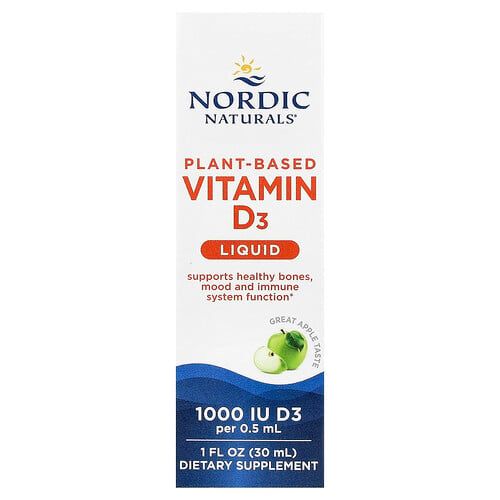
Nordic Naturals Vitamin D3 Liquid, Plant-Based, Great Apple
25 mcg (1,000 IU) vitamin D3 per serving
Liquid vitamin D3, labelled vegan.
Vegan capsule
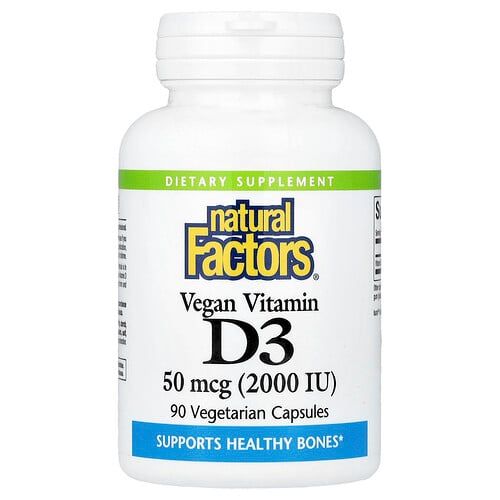
Natural Factors Vegan Vitamin D3 50 mcg (2,000 IU)
50 mcg (2,000 IU) vitamin D3 per serving
Vegan D3 in a gelatin-free capsule, as stated on the label.
Most servings per pack
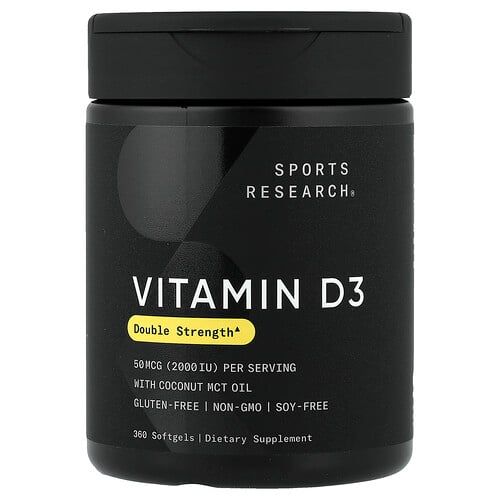
Sports Research Vitamin D3 50 mcg (2,000 IU) with coconut oil
50 mcg (2,000 IU) vitamin D3 per serving
360 servings, the most of the 4 labels here that state it.
Lowest strength per softgel or capsule
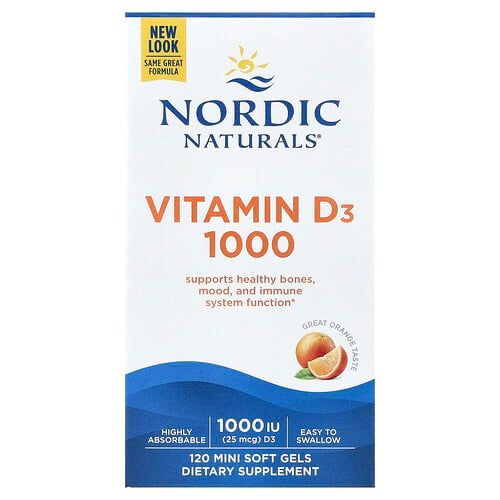
Nordic Naturals Vitamin D3 1000, Orange
25 mcg (1,000 IU) vitamin D3 per serving
The lowest per serving of the softgels and capsules here.
Each pick follows a fixed rule applied to the label facts (labels checked October 17, 2026); nothing here is paid for. Retailer buttons are affiliate links.
How each pick is chosen
- Drops instead of capsules: A liquid rather than softgels or capsules.
- Vegan capsule: Labelled vegan and not a liquid.
- Most servings per pack: The most servings in one pack, shown only when one product clearly leads.
- Lowest strength per softgel or capsule: The lowest amount of D3 per serving among softgels and capsules, shown only when one product clearly has the lowest.
What the research shows
Blood tests for vitamin D measure 25-hydroxyvitamin D, written 25(OH)D. Studies that compare D2 and D3 usually ask which raises this marker more.
The 2012 meta-analysis. Researchers combined randomised trials that directly compared the two forms in adults. D3 raised total 25(OH)D more than D2 overall. When they split the trials by how the vitamin was given, the advantage was clear for large single (“bolus”) doses but was no longer statistically significant for daily doses.
The 2024 meta-analysis. A newer review pooled 20 comparisons and focused on daily or weekly dosing. It found D3 superior to D2 for raising total 25(OH)D, even when only daily studies were included: in the studies measured with the most accurate laboratory method, the rise was about 40% smaller with D2. The authors also noted that the difference largely disappeared in people with a body mass index above 25, a finding they flagged for further research.
Two caveats. First, these studies measure a blood marker, not health outcomes such as bone strength or falls. Second, both forms did raise vitamin D levels; D2 isn’t ineffective, it just appears less efficient.
Where each form comes from
The Vegan Society explains that vitamin D2 isn’t derived from animals, while many D3 supplements use D3 made from lanolin, the grease in sheep’s wool. Vegan D3 made from lichen is also sold, and products that use it say so on the label.
Two things to check on a label if you avoid animal products:
- The source of the vitamin D — “from lichen” or a branded lichen ingredient for vegan D3.
- The capsule or softgel — gelatin capsules are animal-derived even if the vitamin isn’t.
Vegan D3 examples on iHerb
Both of these state a lichen source for their vitamin D3 on the label. We haven’t tested them; the facts below come from their published label records.
One of the few vegan D3 options at 50 mcg, in a dry capsule.
- Vitamin D per serving
- 50 mcg (2,000 IU), 1 capsule
- Form and source
- Vitamin D3 (cholecalciferol) from lichen
- Oil and shell
- Dry capsule: microcrystalline cellulose, vegetarian capsule, magnesium stearate
- Suitable for
- Vegetarians and vegans (label)
Key facts
- Vitamin D3 from lichen, so it is suitable for vegans.
- A dry capsule rather than an oil-filled softgel.
Worth weighing up
- The label suggests 1 capsule once or twice a day; two capsules would be 100 mcg (4,000 IU), the upper limit for adults set by the NIH.
Liquid drops
Nordic Naturals
Vitamin D3 Liquid, Plant-Based, Great Apple
1 fl oz (30 ml)
A vegan liquid D3 at 25 mcg per half millilitre.
- Vitamin D per serving
- 25 mcg (1,000 IU) in 0.5 ml
- Form and source
- Vitamin D3 from lichen (Vitashine)
- Oil and shell
- Medium-chain triglycerides (coconut oil), natural apple flavour
- Suitable for
- Vegans (label)
Key facts
- Liquid drops, for people who would rather not swallow capsules.
- Plant-based D3 from lichen; label states vegan.
Worth weighing up
- Measuring 0.5 ml takes more care than counting capsules.
So which should you choose?
On the current evidence, D3 is the more efficient way to raise vitamin D levels, and vegan D3 means few people have a reason to pick D2 for ethical or dietary reasons alone. D2 remains a reasonable option if it is what you have, or if a doctor prescribes it: the studies show it works, just somewhat less strongly per microgram.
What matters more than the form is the amount. Most people in the UK are advised to consider 10 mcg (400 IU) a day in autumn and winter, and the NHS advises adults not to exceed 100 mcg (4,000 IU) a day. If you have had a blood test, have a kidney condition or take regular medication, ask your doctor what amount suits you.
For a wider comparison of D3 products — oil, capsule type, strength and pack size — see Vitamin D3 Supplements on iHerb Compared.
Sources
The research and official guidance this article draws on.
- Comparison of vitamin D2 and vitamin D3 supplementation in raising serum 25-hydroxyvitamin D status: a systematic review and meta-analysis. The American Journal of Clinical Nutrition, 2012 (checked )
- Comparison of the Effect of Daily Vitamin D2 and Vitamin D3 Supplementation on Serum 25-Hydroxyvitamin D Concentration (Total 25(OH)D, 25(OH)D2, and 25(OH)D3) and Importance of Body Mass Index: A Systematic Review and Meta-Analysis. Advances in Nutrition, 2024 (checked )
- Vitamin D. The Vegan Society (checked )
- Vitamin D. NHS (checked )
- Overview on Tolerable Upper Intake Levels as derived by the Scientific Committee on Food (SCF) and the EFSA Panel on Nutrition (Version 11). European Food Safety Authority, 2025 (checked )
- Natural Factors Vegan Vitamin D3 50 mcg (2000 IU), 90 vegetarian capsules (label 282643). NIH Dietary Supplement Label Database (checked )
- Nordic Naturals Plant-Based Vitamin D3 Liquid (label 223174). NIH Dietary Supplement Label Database (checked )
This article is general information, not medical advice. Whether a supplement suits you depends on your health, diet and any medication you take, which a doctor or pharmacist can help you weigh up. Read our medical disclaimer.
Who wrote this
Nourlume is an independent online publication about supplements, skincare and everyday wellness. Pieces credited to Nourlume rather than a named writer follow our editorial policy, which explains how we research, source and update our work.