Article
Vitamin D IU to mcg: How to Convert the Units on a Label
1 mcg of vitamin D equals 40 IU. A conversion chart for common label strengths, why labels show both units, and how the numbers compare with official limits.
Affiliate links. Some links on this page are affiliate links: if you buy through them, Nourlume may earn a commission at no extra cost to you. Affiliate relationships do not determine our editorial conclusions. About affiliate links
What changed: Added a chart of common strengths against the NHS figures, and answers on µg and ug, milligrams and 50 mcg.

In this article (6)
Vitamin D labels use two units, and they are easy to mix up. 1 microgram (mcg or µg) of vitamin D is equal to 40 International Units (IU). Divide IU by 40 to get micrograms; multiply micrograms by 40 to get IU.
Comparing products? Our comparison of five vitamin D3 supplements sold on iHerb shows each label’s strength in both units, and our multivitamin comparison does the same for five multivitamins. Food tables usually give micrograms too: see vitamin D in fish, eggs, mushrooms and milk.
So a softgel labelled “25 mcg (1,000 IU)” contains the same amount of vitamin D whichever unit you read. The NHS and the European Food Safety Authority (EFSA) both use the same 1 mcg = 40 IU conversion.
Conversion chart for common label strengths
Vitamin D unit converter
25 mcg = 1,000 IU = 0.025 mg. Type in either box and the other one updates.
| Micrograms (mcg) | International Units (IU) | Milligrams (mg) | Where you might see it |
|---|---|---|---|
| 1 mcg | 40 IU | 0.001 mg | The conversion factor |
| 5 mcg | 200 IU | 0.005 mg | Half the NHS daily amount |
| 10 mcg | 400 IU | 0.01 mg | The NHS daily amount for adults and children over 1 |
| 12.5 mcg | 500 IU | 0.0125 mg | e.g. NOW Adam multivitamin (per serving) |
| 15 mcg | 600 IU | 0.015 mg | Some lower-strength products |
| 20 mcg | 800 IU | 0.02 mg | The US Daily Value used on Supplement Facts panels |
| 25 mcg | 1,000 IU | 0.025 mg | e.g. Nordic Naturals Vitamin D3 1000 |
| 50 mcg | 2,000 IU | 0.05 mg | e.g. California Gold Nutrition Vitamin D3 |
| 62.5 mcg | 2,500 IU | 0.0625 mg | e.g. NOW Liquid D-3 & MK-7 (5 drops) |
| 75 mcg | 3,000 IU | 0.075 mg | Between the common 2,000 IU and the 4,000 IU limit |
| 100 mcg | 4,000 IU | 0.1 mg | The NHS maximum for adults; the EFSA upper limit for adults |
| 125 mcg | 5,000 IU | 0.125 mg | “High-potency” products, above both limits |
| 250 mcg | 10,000 IU | 0.25 mg | Very high-strength products, far above both limits |
The same strengths as a picture, with the NHS daily amount, the US Daily Value and the adult maximum marked:

Choose by situation
From 5 labels we checked · no ratings, no “best”
Already know what you need? These are the labels that fit each situation.
Drops instead of capsules
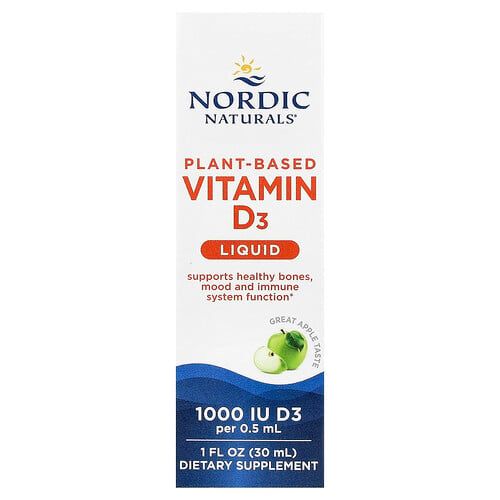
Nordic Naturals Vitamin D3 Liquid, Plant-Based, Great Apple
25 mcg (1,000 IU) vitamin D3 per serving
Liquid vitamin D3, labelled vegan.
Vegan capsule
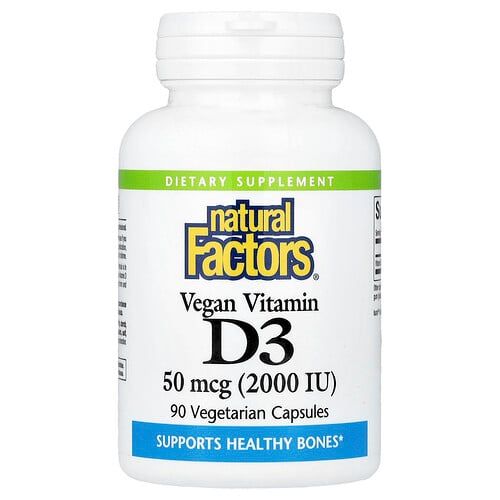
Natural Factors Vegan Vitamin D3 50 mcg (2,000 IU)
50 mcg (2,000 IU) vitamin D3 per serving
Vegan D3 in a gelatin-free capsule, as stated on the label.
Most servings per pack
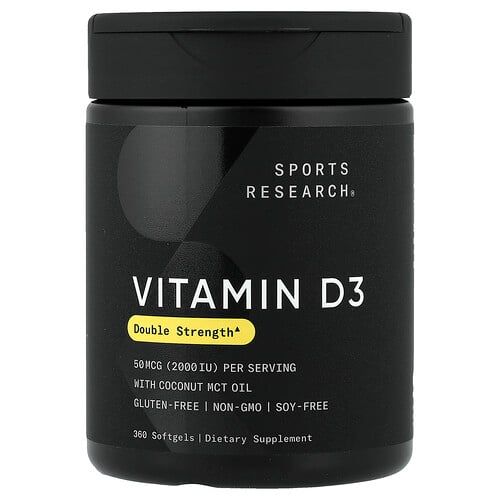
Sports Research Vitamin D3 50 mcg (2,000 IU) with coconut oil
50 mcg (2,000 IU) vitamin D3 per serving
360 servings, the most of the 4 labels here that state it.
Lowest strength per softgel or capsule
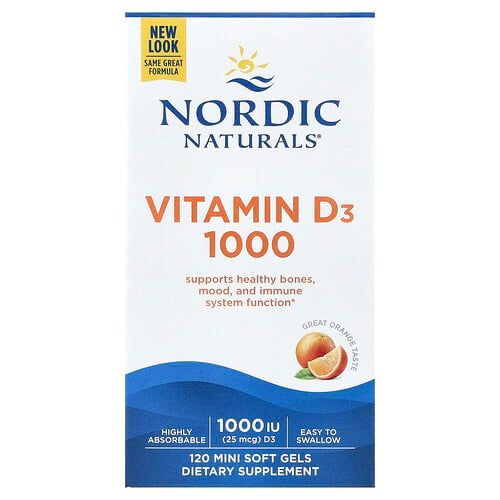
Nordic Naturals Vitamin D3 1000, Orange
25 mcg (1,000 IU) vitamin D3 per serving
The lowest per serving of the softgels and capsules here.
Each pick follows a fixed rule applied to the label facts (labels checked October 17, 2026); nothing here is paid for. Retailer buttons are affiliate links.
How each pick is chosen
- Drops instead of capsules: A liquid rather than softgels or capsules.
- Vegan capsule: Labelled vegan and not a liquid.
- Most servings per pack: The most servings in one pack, shown only when one product clearly leads.
- Lowest strength per softgel or capsule: The lowest amount of D3 per serving among softgels and capsules, shown only when one product clearly has the lowest.
Why labels show both units
In the United States, the FDA’s labelling rules require the amount of vitamin D to be declared in micrograms. Manufacturers may also show IU, but only in brackets after the microgram figure. Labels written for other countries follow their own rules, which is one reason both units are still common.
The % Daily Value on a US Supplement Facts panel is based on 20 mcg (800 IU). A product listing “50 mcg (2,000 IU), 250% DV” is simply saying that 50 is two and a half times 20. A figure over 100% isn’t a warning in itself; it just compares the serving with the reference amount.
How to check a label in three steps
- Find the vitamin D line on the Supplement Facts panel and read the microgram figure.
- Check the serving size. If a serving is two softgels or five drops, the figure covers all of them, not one.
- Add up your sources. If you also take a multivitamin or eat fortified foods, the vitamin D in those counts too.
How the numbers compare with official guidance
The NHS advises that adults and children over 1 need 10 mcg (400 IU) of vitamin D a day, and that everyone should consider a 10 mcg daily supplement in autumn and winter, when UK sunlight isn’t strong enough for the skin to make enough. It recommends a daily supplement all year for people who are rarely outdoors or who usually cover most of their skin, and says people with dark skin should consider one all year too.
On the upper end, the NHS says adults (including pregnant and breastfeeding women and older people) and children aged 11 to 17 should not take more than 100 mcg (4,000 IU) a day, children aged 1 to 10 no more than 50 mcg (2,000 IU), and babies under 12 months no more than 25 mcg (1,000 IU). EFSA sets the same 100 mcg upper level for adults. Too much vitamin D over a long period can raise calcium levels in the blood, which the NHS warns can weaken bones and damage the kidneys and heart.
If a doctor has recommended a different amount, for example after a blood test, their advice applies to you.
Common questions
Is 1,000 IU the same as 1,000 mcg?
No. 1,000 IU is 25 mcg. 1,000 mcg would be 40,000 IU, a very large amount.
Is 5,000 IU of vitamin D too much?
5,000 IU is 125 mcg, which is above the 100 mcg (4,000 IU) maximum the NHS gives for adults and above EFSA’s upper limit. Products at this strength are sold, but the NHS advice is not to go above 100 mcg a day unless a doctor has recommended a different amount.
How many IU is 50 mcg of vitamin D?
2,000 IU (50 × 40). It is one of the most common strengths on iHerb, for example California Gold Nutrition’s Vitamin D3 softgel.
How many mg is 1,000 IU of vitamin D?
0.025 mg. 1,000 IU is 25 mcg, and a milligram is 1,000 micrograms, so 25 mcg = 0.025 mg. That’s why vitamin D is labelled in micrograms rather than milligrams.
What do µg and ug mean on a label?
Both mean micrograms, the same as mcg. The NHS notes that microgram is sometimes written with the Greek symbol µ followed by g (µg); “ug” is the same unit where the µ symbol isn’t available. So 25 ug of vitamin D is 25 mcg, or 1,000 IU.
How many IU are in one drop of vitamin D?
It depends on the product. Liquid labels give the amount per serving, which may be one drop or several. Divide the serving amount by the number of drops in the serving.
Comparing products
Once you can read the units, the next step is comparing what else differs between products: the oil or capsule, whether the vitamin D is suitable for vegans, and how many servings you get. We compared five vitamin D3 supplements sold on iHerb in Vitamin D3 Supplements on iHerb Compared, and explained the difference between the two forms in Vitamin D2 vs D3.
On those five labels the two units sit side by side, and the conversion checks out: 25 mcg × 40 = 1,000 IU, and 50 mcg × 40 = 2,000 IU.
| Product | | | 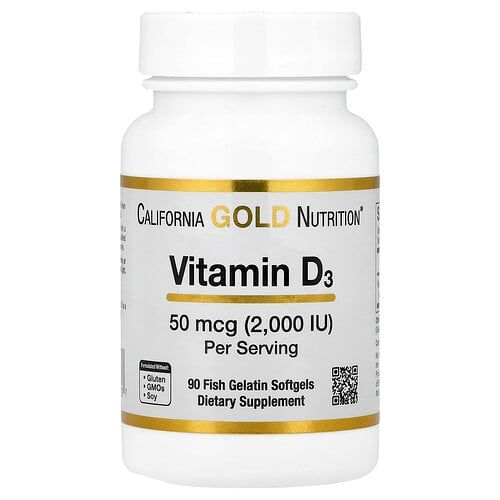 | | |
|---|---|---|---|---|---|
| Vitamin D per serving | 25 mcg (1,000 IU), 1 soft gel | 25 mcg (1,000 IU) in 0.5 ml | 50 mcg (2,000 IU), 1 softgel | 50 mcg (2,000 IU), 1 softgel | 50 mcg (2,000 IU), 1 capsule |
| Form and source | Vitamin D3 (cholecalciferol) | Vitamin D3 from lichen (Vitashine) | Vitamin D3 | Vitamin D3 (cholecalciferol) | Vitamin D3 (cholecalciferol) from lichen |
| Suitable for | Not vegetarian (gelatin) | Vegans (label) | Not vegetarian (fish gelatin); label lists fish as an allergen | Not vegetarian (gelatin); label lists coconut as a tree-nut allergen | Vegetarians and vegans (label) |
| Where to buy |
Sources
The research and official guidance this article draws on.
- Vitamin D. NHS (checked )
- 21 CFR 101.9 — Nutrition labeling of food (table of Reference Daily Intakes, footnote on vitamin D units). Electronic Code of Federal Regulations (checked )
- Daily Value on the Nutrition and Supplement Facts Labels. U.S. Food and Drug Administration (checked )
- Overview on Tolerable Upper Intake Levels as derived by the Scientific Committee on Food (SCF) and the EFSA Panel on Nutrition (Version 11). European Food Safety Authority, 2025 (checked )
This article is general information, not medical advice. Whether a supplement suits you depends on your health, diet and any medication you take, which a doctor or pharmacist can help you weigh up. Read our medical disclaimer.
Who wrote this
Nourlume is an independent online publication about supplements, skincare and everyday wellness. Pieces credited to Nourlume rather than a named writer follow our editorial policy, which explains how we research, source and update our work.