Article
Vitamin D3 and K2 Together: What the Research Shows
Why vitamin D3 and K2 are sold together, what trials of the combination found, the difference between MK-4 and MK-7, and who should be careful with vitamin K.
Affiliate links. Some links on this page are affiliate links: if you buy through them, Nourlume may earn a commission at no extra cost to you. Affiliate relationships do not determine our editorial conclusions. About affiliate links

In this article (6)
Vitamin D3 and vitamin K2 are often sold as a pair, in drops, softgels and capsules. The idea behind the combination is plausible: vitamin D helps regulate calcium in the body, and vitamin K is needed to activate osteocalcin, a protein in bone. Whether taking them together makes a measurable difference to your health is a separate question, and the evidence is thinner than the marketing suggests.
Vitamin K in brief
Vitamin K isn’t one compound. Vitamin K1 (phylloquinone) is found in green leafy vegetables and some vegetable oils. Vitamin K2 is a family of compounds called menaquinones, labelled MK-4, MK-7 and so on.
The European Food Safety Authority (EFSA) has set an adequate intake for vitamin K1 of 70 mcg a day for adults. It didn’t set one for K2, concluding that the evidence on menaquinones was insufficient. EFSA hasn’t set a tolerable upper intake level for vitamin K either, because it found the data inadequate.
MK-4 and MK-7 on supplement labels
Labels name the form of K2. The products we compared use two of them:
| MK-4 | MK-7 | |
|---|---|---|
| Example on a label | California Gold Nutrition D3 + K2 drops: 200 mcg MK-4 per serving | NOW Liquid D-3 & MK-7: 100 mcg MK-7 per serving |
| What a 2007 study found | Not studied there | Absorbed well, with a very long half-life: with daily use, levels built up 7 to 8 times higher than with vitamin K1 |
Because MK-7 builds up with daily use, the study’s authors warned doctors that supplements providing 50 mcg a day or more of MK-7 may interfere with oral anticoagulants in a clinically relevant way.
What trials of the combination found
Bone density. A 2020 meta-analysis pooled eight randomised trials with 971 participants that combined vitamin K with vitamin D. Total bone mineral density increased slightly more with the combination than without it, and a marker of inactive osteocalcin (a bone protein that vitamin K activates) went down. The pooled effect was modest, and bone density is a measurement rather than an outcome such as fewer fractures.
Fractures. A 2019 systematic review of 36 trials of oral vitamin K supplementation looked at bone density and fractures in adults. In post-menopausal women and people with osteoporosis, it found no evidence of an effect on bone density or spinal fractures. Clinical fractures were somewhat less common with vitamin K, but the difference shrank and stopped being statistically significant when only the more reliable trials were included. The authors concluded the evidence was insufficient to confirm a benefit, and that there were too few trials in other groups to draw conclusions.
Heart and blood vessels. Claims that K2 keeps calcium “out of the arteries” are common on product pages. We didn’t find trial evidence strong enough to support those claims for supplements, so we don’t repeat them.
Reading a D3 + K2 label
- Vitamin D amount. Check the micrograms per serving and the suggested number of servings a day. The NHS advises adults not to exceed 100 mcg (4,000 IU) a day.
- K2 form and amount. Look for MK-4 or MK-7 and the micrograms per serving. Amounts vary widely.
- Serving size for drops. Liquid servings can be two drops or five, so the per-drop amount differs between brands.
- Warnings. Some labels, such as NOW’s, tell people taking anticoagulants to consult a doctor first. That applies to every vitamin K product, whether or not the label says so.
Three D3 + K2 liquids on iHerb, compared
These three show how much products in the same category differ. The figures come from each product’s published label record; we haven’t tested the products.
| Product | 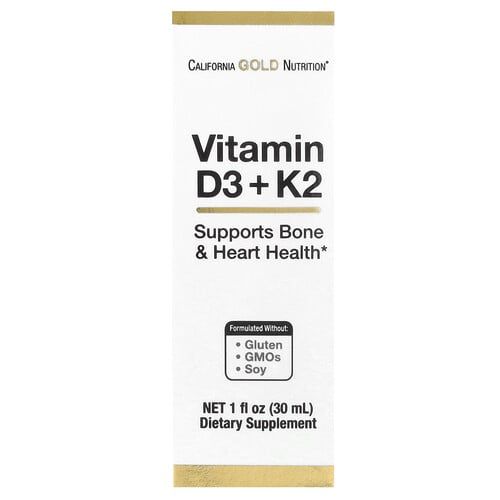 | 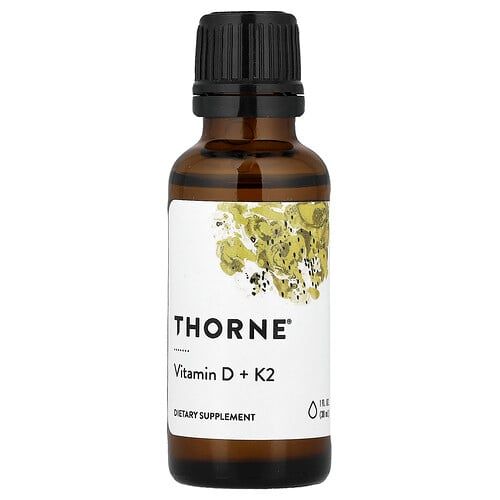 | 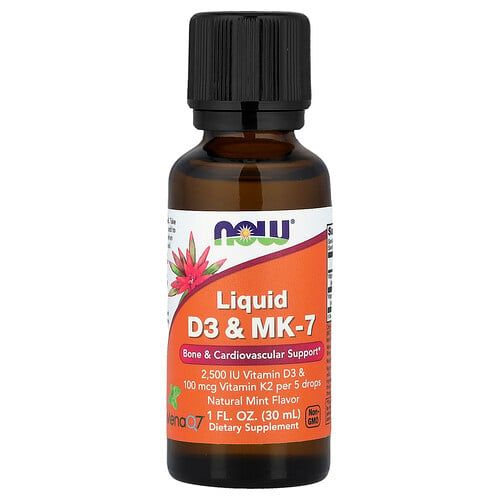 |
|---|---|---|---|
| Vitamin D per serving | 25 mcg (1,000 IU), 2 drops | 25 mcg (1,000 IU), 2 drops | 62.5 mcg (2,500 IU), 5 drops |
| Vitamin K2 per serving | 200 mcg, as MK-4 | 200 mcg (form not specified in the label record) | 100 mcg, as MK-7 (MenaQ7) |
| Oil and shell | Medium-chain triglyceride (MCT) oil | MCT oil, mixed tocopherols | MCT, sunflower and safflower oils; peppermint oil; vitamin E; rosemary extract |
| Servings per pack | About 460 (label) | 600 (label) | About 163 (label) |
| Where to buy |
A low-strength D3 + K2 liquid that uses the MK-4 form of vitamin K2.
- Vitamin D per serving
- 25 mcg (1,000 IU), 2 drops
- Vitamin K2 per serving
- 200 mcg, as MK-4
- Oil and shell
- Medium-chain triglyceride (MCT) oil
Key facts
- Two drops provide 25 mcg (1,000 IU) of D3 and 200 mcg of K2 as menaquinone-4 (MK-4).
- A single other ingredient: MCT oil.
Worth weighing up
- Contains vitamin K, which can affect blood-thinning medicines such as warfarin.
- Drops are small: counting two per serving takes some care.
A D3 + K2 liquid with third-party content certification on the label.
- Vitamin D per serving
- 25 mcg (1,000 IU), 2 drops
- Vitamin K2 per serving
- 200 mcg (form not specified in the label record)
- Oil and shell
- MCT oil, mixed tocopherols
Key facts
- Same per-serving amounts as the California Gold Nutrition drops: 25 mcg D3 and 200 mcg K2.
- Label carries the NSF Contents Certified mark.
Worth weighing up
- The label suggests 2 drops one to three times a day, so daily vitamin D ranges from 25 to 75 mcg depending on use.
- Contains vitamin K, which can affect blood-thinning medicines such as warfarin.
A mint-flavoured D3 + MK-7 liquid, stronger in vitamin D than the other drops in this group.
- Vitamin D per serving
- 62.5 mcg (2,500 IU), 5 drops
- Vitamin K2 per serving
- 100 mcg, as MK-7 (MenaQ7)
- Oil and shell
- MCT, sunflower and safflower oils; peppermint oil; vitamin E; rosemary extract
Key facts
- K2 as menaquinone-7 (MK-7), the form used in many K2 studies.
- Label carries halal and kosher symbols.
Worth weighing up
- Higher vitamin D per serving (62.5 mcg) than the other D3 + K2 drops we looked at.
- The label tells people taking anticoagulants such as warfarin to consult a physician first.
The bottom line
A D3 + K2 product is a reasonable way to take vitamin D if you also want vitamin K and aren’t on an anticoagulant. But the K2 is an add-on with modest, uncertain evidence behind it, not a requirement for vitamin D to “work”. If what you need is vitamin D, a plain D3 product does that job; we compare several in Vitamin D3 Supplements on iHerb Compared. K2 on its own, in capsules and softgels (MK-7 and MK-4), is compared in Vitamin K2 on iHerb: Eight Labels Compared.
Sources
The research and official guidance this article draws on.
- The combination effect of vitamin K and vitamin D on human bone quality: a meta-analysis of randomized controlled trials. Food & Function, 2020 (checked )
- Effect of vitamin K on bone mineral density and fractures in adults: an updated systematic review and meta-analysis of randomised controlled trials. Osteoporosis International, 2019 (checked )
- Vitamin K-containing dietary supplements: comparison of synthetic vitamin K1 and natto-derived menaquinone-7. Blood, 2007 (checked )
- Dietary reference values for vitamin K. EFSA Journal, 2017 (checked )
- Overview on Tolerable Upper Intake Levels as derived by the Scientific Committee on Food (SCF) and the EFSA Panel on Nutrition (Version 11). European Food Safety Authority, 2025 (checked )
- Warfarin. MedlinePlus, U.S. National Library of Medicine (checked )
- Vitamin D. NHS (checked )
- California Gold Nutrition Vitamin D3 + K2 (label 299719); Thorne Vitamin D + K2 (label 336339); NOW Liquid D-3 & MK-7 (label 314423). NIH Dietary Supplement Label Database (checked )
This article is general information, not medical advice. Whether a supplement suits you depends on your health, diet and any medication you take, which a doctor or pharmacist can help you weigh up. Read our medical disclaimer.
Who wrote this
Nourlume is an independent online publication about supplements, skincare and everyday wellness. Pieces credited to Nourlume rather than a named writer follow our editorial policy, which explains how we research, source and update our work.