Buying guide
Lutein Supplements on iHerb: Five Labels Compared
Five lutein supplements sold on iHerb compared on their labels: lutein and zeaxanthin per softgel, free lutein vs esters, the softgel and allergens.
Affiliate links. Some links on this page are affiliate links: if you buy through them, Nourlume may earn a commission at no extra cost to you. Affiliate relationships do not determine our editorial conclusions. About affiliate links
Choose by situation
From the 5 labels compared below · no ratings, no “best”
Shown for the country your connection appears to come from (we don’t store it). iHerb sets the terms, so check that the discount applies at checkout. Affiliate link.
Most lutein per serving
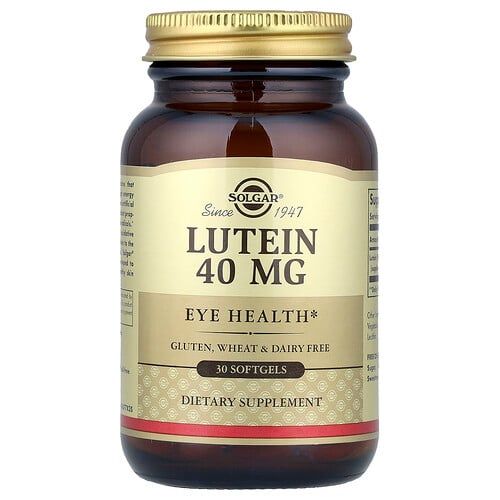
Solgar Lutein 40 mg
40 mg lutein + 2 mg zeaxanthin per serving
The most of the 4 labels here that state it.
Most zeaxanthin
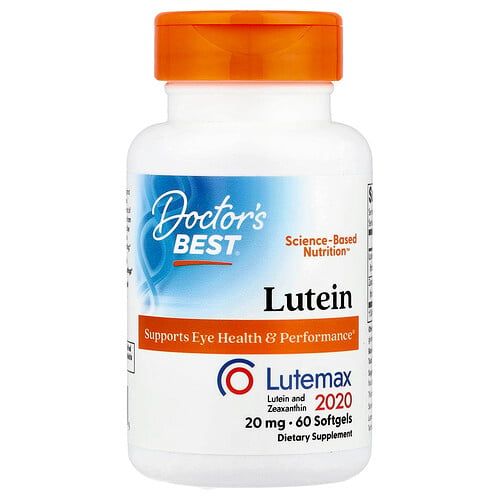
Doctor’s Best Lutein with Lutemax 2020, 20 mg
20 mg lutein + 4 mg zeaxanthin per serving
The most of the 3 labels here that state it.
Plant-based softgel
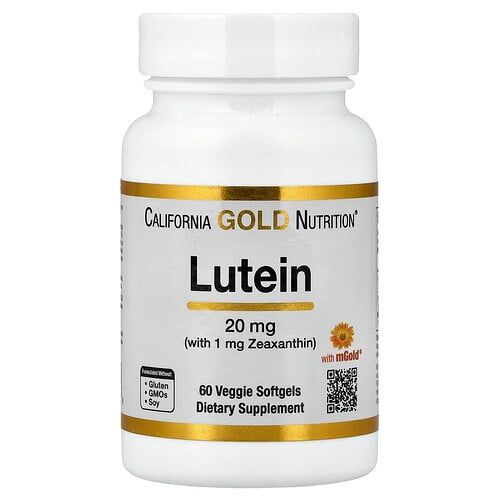
California Gold Nutrition Lutein 20 mg with Zeaxanthin
20 mg lutein + 1 mg zeaxanthin per serving
The softgel is plant-based, as stated on the label.
Lowest amount
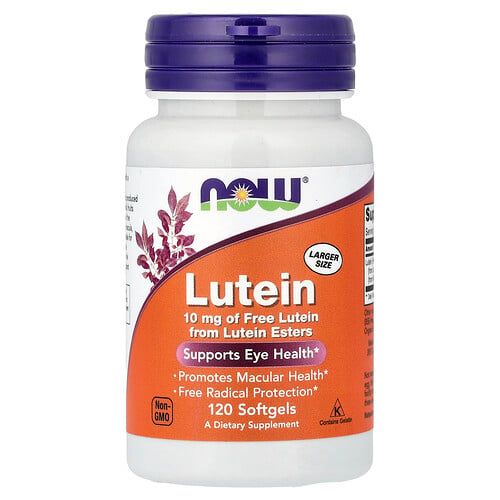
NOW Foods Lutein 10 mg
10 mg lutein per serving
The least of the 4 labels here that state it.
Each pick follows a fixed rule applied to the label facts (labels checked November 3, 2026); nothing here is paid for. Retailer buttons are affiliate links. Strengths and limitations of each product are further down.
How each pick is chosen
- Most lutein per serving: The most lutein per serving, shown only when one product clearly leads.
- Most zeaxanthin: The most zeaxanthin per serving, shown only when one product clearly leads.
- Plant-based softgel: The label states a vegetarian or plant-based softgel.
- Lowest amount: The least lutein per serving, shown only when one product clearly has the least.
In this article (7)
Lutein labels mostly compete on one number, 10, 20 or 40 mg, and sometimes on a second one for zeaxanthin. Those numbers aren’t always measured the same way, and the softgels around them differ too. This comparison lines up five lutein supplements sold on iHerb on what their labels actually say: how much lutein and zeaxanthin, whether the figure is free lutein or lutein esters, where the lutein comes from, and what the softgel is made of.
How we chose these five
- Sold on iHerb, with a label record in the US National Institutes of Health’s Dietary Supplement Label Database (DSLD) that matches the iHerb listing by barcode. Two other lutein products we looked at didn’t pass this check, so they aren’t here.
- Lutein as the main ingredient. We left out eye formulas that combine lutein with many vitamins, minerals or other extracts: they are a different kind of product.
- Different approaches: a low and a high amount, products with and without zeaxanthin, a plant-based softgel, and a label that gives the ester weight.
We haven’t tested these products and don’t rank them. Each one is described by its label, and our guide to reading a Supplement Facts label explains the general parts of the panel.
The labels side by side
| Product | | | | | 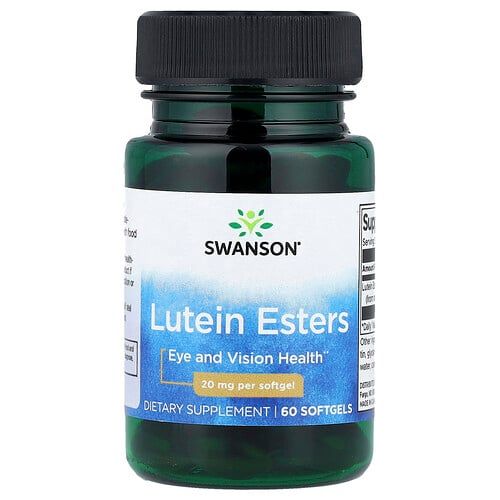 |
|---|---|---|---|---|---|
| Lutein per serving | 10 mg (free lutein, from lutein esters) | 20 mg | 20 mg | 40 mg (FloraGLO) | 20 mg of lutein esters (free lutein not stated) |
| Zeaxanthin per serving | Not listed | 1 mg | 4 mg (zeaxanthin isomers) | 2 mg | Not listed |
| Lutein source | Marigold flower extract | Marigold flower extract | Marigold flower extract (Lutemax 2020) | FloraGLO lutein (branded ingredient) | Marigold flower extract |
| Shell and additives | Bovine gelatin softgel; extra virgin olive oil | Plant-based softgel (modified starch, carrageenan); safflower and sunflower oil | Softgel (material not stated); sunflower oil | Gelatin softgel; safflower oil, beeswax, soy lecithin | Gelatin softgel; sunflower oil, beeswax, carob |
| Servings per pack | 120 | 60 | 60 | 30 | 60 |
| Where to buy |
What the comparison shows
Free lutein or lutein esters. In marigold petals, most lutein is bound to fatty acids as lutein esters. A label can give the weight of those esters or the amount of lutein they provide. NOW’s label says its 10 mg is free lutein from lutein esters. Swanson’s says 20 mg of lutein esters and stops there. Because the ester weight includes the fatty acids, 20 mg of esters contains less than 20 mg of lutein: in a lutein molecule bound to two palmitic acids, for example, lutein is only a little over half the weight. The form itself isn’t a problem. In a small study, a lutein diester was absorbed at least as well as unesterified lutein, and the authors suggested that how well the formulation dissolves matters more. The issue is only that the Swanson label can’t be compared directly with the others.
Zeaxanthin. Zeaxanthin is the second carotenoid, with lutein, in the macula, the centre of the retina. Three labels list it: 1 mg in California Gold Nutrition, 2 mg in Solgar and 4 mg of “zeaxanthin isomers” in Doctor’s Best. NOW and Swanson list none. The AREDS2 trial used 10 mg of lutein with 2 mg of zeaxanthin, a 5:1 ratio. No product here matches it exactly: NOW has the same lutein but no zeaxanthin; Doctor’s Best has the same ratio at twice the amount; Solgar has the same zeaxanthin with four times the lutein.
From 10 to 40 mg. The amounts per softgel span a factor of four. None of these labels explains why it chose its amount, and AREDS2 tested 10 mg, not the larger amounts. For a sense of scale, USDA data put a cup of cooked spinach at about 20 mg of lutein and zeaxanthin combined (see the table below).
Branded ingredients. Doctor’s Best uses Lutemax 2020, a trademark of OmniActive Health Technologies, and Solgar uses FloraGLO, a trademark of Kemin Industries. Both are lutein ingredients from named suppliers, and the Doctor’s Best label says Lutemax 2020 comes from marigold flower extract. A brand name tells you who made the ingredient; it isn’t evidence that the product does more.
The softgel. Lutein dissolves in fat, so all five come as oil-filled softgels, and four labels suggest taking them with food or a meal. California Gold Nutrition’s softgel is plant-based (modified starch and carrageenan). NOW’s is bovine gelatin, and Swanson’s and Solgar’s are gelatin without a stated source. Doctor’s Best doesn’t name the softgel material. Solgar contains soy lecithin.
Claims on the label. Doctor’s Best and Solgar mention protection from blue light from the sun, screens or indoor lighting. These are the manufacturers’ claims, printed with the standard notice that the FDA hasn’t evaluated them. AREDS2 didn’t study screen use or eye strain.
The products
A 10 mg lutein that states the free lutein amount; no zeaxanthin listed; bovine gelatin softgel.
- Serving size
- 1 softgel
- Lutein per serving
- 10 mg (free lutein, from lutein esters)
- Zeaxanthin per serving
- Not listed
- Lutein source
- Marigold flower extract
- Shell and additives
- Bovine gelatin softgel; extra virgin olive oil
- Servings per pack
- 120
Key facts
- 10 mg of free lutein per softgel, the lutein amount used in the AREDS2 trial; the label states the free lutein, not the ester weight.
- The label suggests taking it with a fat-containing meal.
Worth weighing up
- Zeaxanthin isn’t listed.
- The softgel is made of bovine gelatin, so it doesn’t suit vegetarians.
Plant-based softgel
California Gold Nutrition
Lutein 20 mg with Zeaxanthin
60 veggie softgels
iHerb’s own-brand lutein in a plant-based softgel: 20 mg of lutein with 1 mg of zeaxanthin.
- Serving size
- 1 softgel
- Lutein per serving
- 20 mg
- Zeaxanthin per serving
- 1 mg
- Lutein source
- Marigold flower extract
- Shell and additives
- Plant-based softgel (modified starch, carrageenan); safflower and sunflower oil
- Servings per pack
- 60
Key facts
- 20 mg of lutein and 1 mg of zeaxanthin from marigold extract in one plant-based softgel.
- The label suggests taking it with food.
Worth weighing up
- The label asks pregnant or breastfeeding women, people under 18, anyone on prescription medicines such as blood thinners and anyone with a medical condition to consult a professional first.
- Its lutein-to-zeaxanthin ratio is 20:1; the AREDS2 trial used 10 mg to 2 mg (5:1).
Lutein with the most zeaxanthin here (4 mg of isomers, Lutemax 2020); the softgel material isn’t stated.
- Serving size
- 1 softgel
- Lutein per serving
- 20 mg
- Zeaxanthin per serving
- 4 mg (zeaxanthin isomers)
- Lutein source
- Marigold flower extract (Lutemax 2020)
- Shell and additives
- Softgel (material not stated); sunflower oil
- Servings per pack
- 60
Key facts
- 20 mg of lutein with 4 mg of zeaxanthin isomers: the most zeaxanthin in our comparison.
- The label allows taking it with or without food.
Worth weighing up
- The label doesn’t say what the softgel is made of.
- Its blue-light and screen-use claims are the manufacturer’s, made under the standard FDA disclaimer; they aren’t evaluated by the FDA.
The highest-dose lutein here, 40 mg with 2 mg of zeaxanthin; contains soy lecithin.
- Serving size
- 1 softgel
- Lutein per serving
- 40 mg (FloraGLO)
- Zeaxanthin per serving
- 2 mg
- Lutein source
- FloraGLO lutein (branded ingredient)
- Shell and additives
- Gelatin softgel; safflower oil, beeswax, soy lecithin
- Servings per pack
- 30
Key facts
- 40 mg of lutein with 2 mg of zeaxanthin per softgel: the most lutein in our comparison.
- The label suggests one softgel at mealtime.
Worth weighing up
- 40 mg is four times the lutein used in the AREDS2 trial; the label gives no reason for that amount.
- Contains soy lecithin, and the softgel is gelatin.
Lists 20 mg of lutein esters rather than free lutein, so the actual lutein content isn’t stated; no zeaxanthin listed.
- Serving size
- 1 softgel
- Lutein per serving
- 20 mg of lutein esters (free lutein not stated)
- Zeaxanthin per serving
- Not listed
- Lutein source
- Marigold flower extract
- Shell and additives
- Gelatin softgel; sunflower oil, beeswax, carob
- Servings per pack
- 60
Key facts
- 20 mg of lutein esters from marigold extract per softgel.
- The label suggests one softgel a day with food and water.
Worth weighing up
- The 20 mg is the weight of lutein esters, which includes the fatty acids bound to the lutein; the label doesn’t say how much free lutein that equals, so it isn’t directly comparable with “20 mg of lutein”.
- Zeaxanthin isn’t listed.
What the research did and didn’t show
The best-known lutein research is AREDS2, a randomised trial run by the US National Eye Institute that followed participants for a median of five years. It enrolled 4,203 people aged 50 to 85 who already had signs putting them at risk of advanced age-related macular degeneration (AMD). Participants also took a version of the vitamin and mineral formula from the earlier AREDS trial. In the main analysis, adding 10 mg of lutein and 2 mg of zeaxanthin didn’t significantly reduce progression to advanced AMD compared with placebo. The trial also tested omega-3 fatty acids (350 mg of DHA with 650 mg of EPA), which didn’t reduce it either.
The same trial found more lung cancers, mostly in former smokers, among people given beta carotene, part of the older formula. The researchers concluded that lutein and zeaxanthin could be an appropriate replacement for it. A 10-year follow-up published in 2022 supported that: lutein and zeaxanthin weren’t linked to a statistically significant increase in lung cancer, and compared with beta carotene they had a potential benefit for AMD progression.
What this research doesn’t tell you: whether lutein helps people without these eye changes, whether more than 10 mg does anything extra, or anything about screens and eye strain. If you are thinking about lutein because of an eye condition, that is a question for an eye doctor, who can tell you whether a formula like the one in AREDS2 applies to you.
Lutein from food
Lutein and zeaxanthin are in many green vegetables, and some foods provide amounts similar to a supplement. These figures come from the US Department of Agriculture’s FoodData Central database, which reports lutein and zeaxanthin together:
| Food | Serving | Lutein + zeaxanthin |
|---|---|---|
| Spinach, cooked | 1 cup (180 g) | 20.4 mg |
| Kale, cooked | 1 cup (118 g) | 5.9 mg |
| Green peas, cooked | 1 cup (160 g) | 4.1 mg |
| Spinach, raw | 1 cup (30 g) | 3.7 mg |
| Sweet corn, cooked | 1 cup (149 g) | 1.4 mg |
| Romaine lettuce, raw | 1 cup shredded (47 g) | 1.1 mg |
| Broccoli, cooked | ½ cup (78 g) | 0.8 mg |
| Egg, hard-boiled | 1 large (50 g) | 0.2 mg |
The figures are averages; real vegetables vary with variety, season and cooking.
Before you buy
Check the safety notes below, especially if you smoke or used to. In Korea, the food safety ministry (MFDS) tells infants, children and pregnant or breastfeeding women to avoid lutein supplements, and some of these labels ask people who are pregnant, breastfeeding or taking prescription medicines to consult a professional first.
Sources
The research and official guidance this article draws on.
- California Gold Nutrition Lutein with Zeaxanthin, 60 veggie softgels (label 275662). NIH Dietary Supplement Label Database (checked )
- NOW Lutein 10 mg, 120 softgels (label 315751). NIH Dietary Supplement Label Database (checked )
- Doctor’s Best Lutein with Lutemax 2020 20 mg, 60 softgels (label 269662). NIH Dietary Supplement Label Database (checked )
- Swanson Lutein Esters 20 mg, 60 softgels (label 202817). NIH Dietary Supplement Label Database (checked )
- Solgar Lutein 40 mg, 30 softgels (label 44502). NIH Dietary Supplement Label Database (checked )
- Lutein + zeaxanthin and omega-3 fatty acids for age-related macular degeneration: the Age-Related Eye Disease Study 2 (AREDS2) randomized clinical trial. JAMA, 2013 (checked )
- Long-term Outcomes of Adding Lutein/Zeaxanthin and ω-3 Fatty Acids to the AREDS Supplements on Age-Related Macular Degeneration Progression: AREDS2 Report 28. JAMA Ophthalmology, 2022 (checked )
- Long-term use of beta-carotene, retinol, lycopene, and lutein supplements and lung cancer risk: results from the VITamins And Lifestyle (VITAL) study. American Journal of Epidemiology, 2009 (checked )
- Esterification does not impair lutein bioavailability in humans. Journal of Nutrition, 2002 (checked )
- FoodData Central, SR Legacy (April 2018 release): lutein + zeaxanthin and portion weights for food IDs 168463, 169238, 170420, 168462, 169999, 169247, 169967, 173424. U.S. Department of Agriculture (checked )
- 선물한 루테인…담배피는 아빠에겐 ‘독’ (report on MFDS cautions for marigold-extract lutein, in Korean). Newsis, 2023 (checked )
This article is general information, not medical advice. Whether a supplement suits you depends on your health, diet and any medication you take, which a doctor or pharmacist can help you weigh up. Read our medical disclaimer.
Who wrote this
Nourlume is an independent online publication about supplements, skincare and everyday wellness. Pieces credited to Nourlume rather than a named writer follow our editorial policy, which explains how we research, source and update our work.