Buying guide
Probiotic Supplements on iHerb: Four Labels Compared
Four probiotics sold on iHerb compared on their labels: CFU per capsule, named strains, whether the count lasts until expiry, storage and allergens.
Affiliate links. Some links on this page are affiliate links: if you buy through them, Nourlume may earn a commission at no extra cost to you. Affiliate relationships do not determine our editorial conclusions. About affiliate links
Choose by situation
From the 4 labels compared below · no ratings, no “best”
Shown for the country your connection appears to come from (we don’t store it). iHerb sets the terms, so check that the discount applies at checkout. Affiliate link.
Every strain named with its code
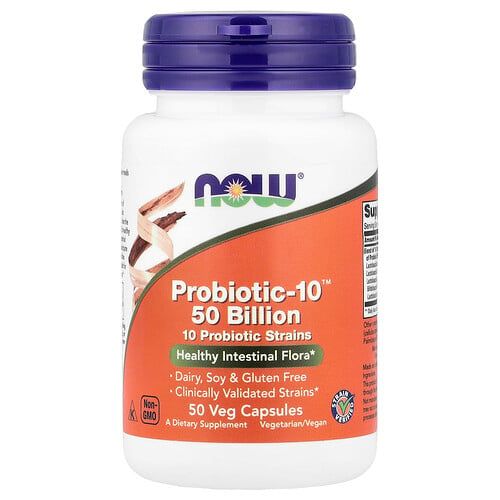
NOW Foods Probiotic-10, 50 Billion
50 billion CFU per serving
All 10 strains are listed with their strain codes.
One identified strain
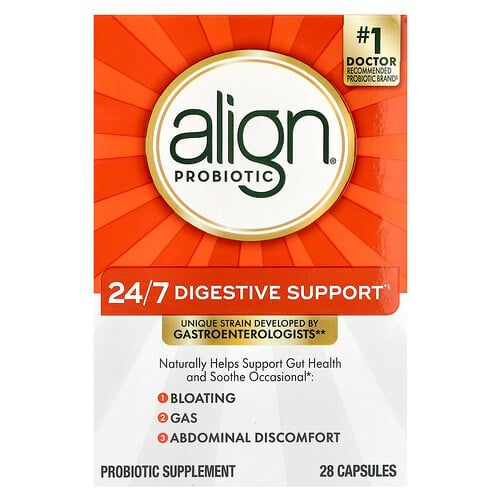
Align 24/7 Digestive Support Probiotic
1 billion CFU per serving
A single strain, named with its strain code.
Most CFU per serving
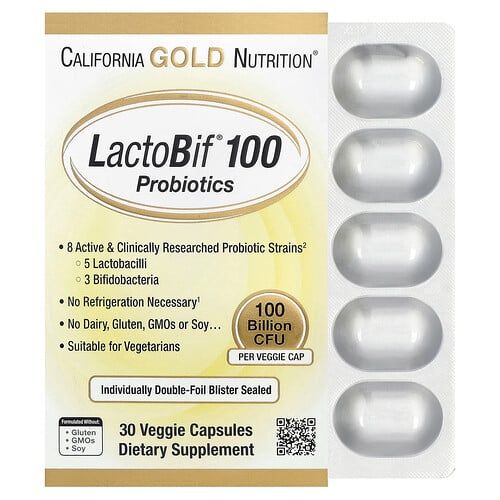
California Gold Nutrition LactoBif 100 Probiotics, 100 Billion CFU
100 billion CFU per serving
The most of the 4 labels compared here; the label guarantees the count until the expiry date.
Each pick follows a fixed rule applied to the label facts (labels checked November 3, 2026); nothing here is paid for. Retailer buttons are affiliate links. Strengths and limitations of each product are further down.
How each pick is chosen
- Every strain named with its code: Several strains, each listed with its strain code; if there are several such labels, the one with more strains.
- One identified strain: A single strain, listed with its strain code.
- Most CFU per serving: The highest CFU count per serving, shown only when one product clearly leads.
In this article (5)
Probiotic labels compete on one big number: 30 billion, 50 billion, 100 billion CFU. That number tells you only part of what you need to know. This comparison lines up four probiotics sold on iHerb on what their labels actually say: how many CFU, which organisms down to the strain, whether the count is still promised at the expiry date, how to store them and what else is in the capsule.
How we chose these four
- Sold on iHerb, with a label record in the US National Institutes of Health’s Dietary Supplement Label Database that matches the iHerb listing by barcode.
- Different approaches: two high-count blends from the same brand, a blend that names every strain, and a single-strain product.
- General adult products. We left out formulas sold for a specific condition, for children or for pets, which need their own evidence.
We haven’t tested these products and don’t rank them. Each one is described by its label, and our guide to reading a probiotic label explains every line we compare.
The labels side by side
| Product | | | 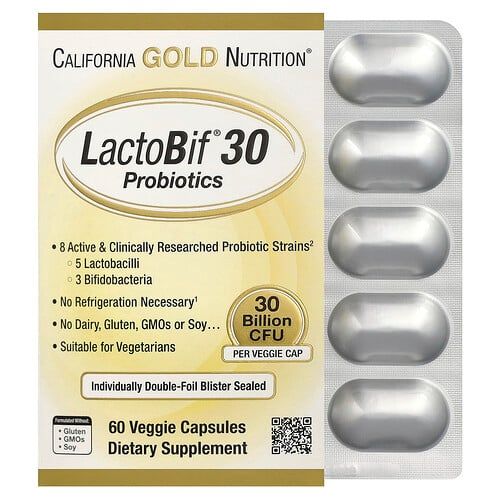 | |
|---|---|---|---|---|
| CFU per serving | 100 billion | 50 billion | 30 billion | 1 billion at manufacture |
| Organisms on the label | 8 species: L. acidophilus, B. animalis subsp. lactis, L. rhamnosus, L. plantarum, B. longum, B. breve, L. casei, L. salivarius | 10 strains: L. acidophilus LA-14, B. lactis BL-04, L. plantarum LP-115, L. casei LC-11, L. rhamnosus LR-32, L. paracasei Lpc-37, B. breve BB-3, S. thermophilus ST-21, L. salivarius LS-33, B. longum BL-5 | 8 species: L. acidophilus, B. animalis subsp. lactis, L. rhamnosus, L. plantarum, B. longum, B. breve, L. casei, L. salivarius | 1 strain: Bifidobacterium longum subsp. longum 35624 |
| Strain codes on the label | No (species only) | Yes, for all 10 | No (species only) | Yes (35624) |
| When the CFU count applies | Until the expiry date, if stored at 25 °C (77 °F) or below | Through the Best By date | Until the expiry date, if stored at 25 °C (77 °F) or below | 1 billion at manufacture; at least 10 million until the best-by date |
| Storage | Room temperature; refrigeration not required but recommended; foil blister packs | Cool, dry place | Room temperature; refrigeration not required but recommended; foil blister packs | Below 30 °C (86 °F) in the original blister; no refrigeration required |
| Servings per pack | 30 | 50 | 60 | 28 |
| Where to buy |
What the comparison shows
More CFU, same organisms. LactoBif 30 and LactoBif 100 list the same eight species; the difference is 30 versus 100 billion CFU per capsule. Neither label gives a breakdown by species, so you can’t see how much of any one organism you get. A higher count isn’t automatically better: the useful question is whether the amount matches what was studied for that strain.
Strain codes. NOW Probiotic-10 gives a code for all ten strains (for example L. acidophilus LA-14), and Align names its single strain, Bifidobacterium longum 35624. The LactoBif labels stop at the species. That matters because, as NCCIH puts it, different types of probiotics may have different effects: research on one strain doesn’t carry over to another of the same species. With a strain code you can look the research up; without one you can’t.
When the count applies. Live microbes die during a product’s shelf life, as the FDA notes in its draft guidance on probiotic labelling. Three labels promise their count until the expiry or best-by date, the LactoBif ones on condition that the capsules are kept at 25 °C (77 °F) or below. Align’s label works differently: 1 billion CFU at manufacture, and at least 10 million by the best-by date, 1% of the starting figure.
Storage. None of the four needs refrigeration according to its label. LactoBif and Align capsules are sealed in individual blister packs; the LactoBif labels still recommend refrigeration, and Align asks for storage below 30 °C (86 °F) in the original blister. NOW asks for a cool, dry place.
Other ingredients. Align contains sodium caseinate, a milk protein, as well as sucrose. NOW adds fructooligosaccharides (FOS), a prebiotic fibre. The LactoBif capsules list only two forms of cellulose and two flow agents.
The products
Highest CFU here
California Gold Nutrition
LactoBif 100 Probiotics, 100 Billion CFU
30 veggie capsules
The same 8 species as LactoBif 30 at 100 billion CFU per capsule; the strains still aren’t identified.
- Serving size
- 1 capsule
- CFU per serving
- 100 billion
- Organisms on the label
- 8 species: L. acidophilus, B. animalis subsp. lactis, L. rhamnosus, L. plantarum, B. longum, B. breve, L. casei, L. salivarius
- Strain codes on the label
- No (species only)
- When the CFU count applies
- Until the expiry date, if stored at 25 °C (77 °F) or below
- Storage
- Room temperature; refrigeration not required but recommended; foil blister packs
- Servings per pack
- 30
- Other ingredients
- Microcrystalline cellulose, modified cellulose, silicon dioxide, magnesium stearate
Key facts
- 100 billion CFU per capsule, the highest count in our comparison.
- Same 8 species as LactoBif 30, with potency guaranteed until the expiry date when stored at 25 °C or below.
Worth weighing up
- It provides more CFU of the same unidentified strains; the label gives no per-species breakdown.
- A 30-capsule pack: one month at the suggested one capsule a day.
Ten strains, each with a strain code, and a 50 billion CFU count stated through the Best By date.
- Serving size
- 1 capsule
- CFU per serving
- 50 billion
- Organisms on the label
- 10 strains: L. acidophilus LA-14, B. lactis BL-04, L. plantarum LP-115, L. casei LC-11, L. rhamnosus LR-32, L. paracasei Lpc-37, B. breve BB-3, S. thermophilus ST-21, L. salivarius LS-33, B. longum BL-5
- Strain codes on the label
- Yes, for all 10
- When the CFU count applies
- Through the Best By date
- Storage
- Cool, dry place
- Servings per pack
- 50
- Other ingredients
- Microcrystalline cellulose, hypromellose (capsule), fructooligosaccharides (FOS), ascorbyl palmitate, silicon dioxide
Key facts
- The only multi-strain product in our comparison that gives a strain code for every organism, so each strain can be looked up.
- 50 billion CFU per capsule, formulated to deliver that count through the Best By date.
Worth weighing up
- The label gives no breakdown of how many CFU come from each strain.
- The label suggests taking it between meals or on an empty stomach.
iHerb’s own brand
California Gold Nutrition
LactoBif 30 Probiotics, 30 Billion CFU
60 veggie capsules
iHerb’s own-brand blend of 8 species at 30 billion CFU, shelf-stable in blister packs; the strains aren’t identified.
- Serving size
- 1 capsule
- CFU per serving
- 30 billion
- Organisms on the label
- 8 species: L. acidophilus, B. animalis subsp. lactis, L. rhamnosus, L. plantarum, B. longum, B. breve, L. casei, L. salivarius
- Strain codes on the label
- No (species only)
- When the CFU count applies
- Until the expiry date, if stored at 25 °C (77 °F) or below
- Storage
- Room temperature; refrigeration not required but recommended; foil blister packs
- Servings per pack
- 60
- Other ingredients
- Microcrystalline cellulose, modified cellulose, silicon dioxide, magnesium stearate
Key facts
- 30 billion CFU in one capsule, with potency guaranteed until the expiry date when stored at 25 °C or below.
- Each capsule is sealed in a foil blister pack, and the label says refrigeration isn’t required.
Worth weighing up
- The label names 8 species but no strain codes, so you can’t look up research on the exact strains.
- The label gives no breakdown of how many CFU come from each species.
A single-strain probiotic: far fewer CFU than the others, but the strain is identified; contains milk.
- Serving size
- 1 capsule
- CFU per serving
- 1 billion at manufacture
- Organisms on the label
- 1 strain: Bifidobacterium longum subsp. longum 35624
- Strain codes on the label
- Yes (35624)
- When the CFU count applies
- 1 billion at manufacture; at least 10 million until the best-by date
- Storage
- Below 30 °C (86 °F) in the original blister; no refrigeration required
- Servings per pack
- 28
- Other ingredients
- Microcrystalline cellulose, hypromellose, sucrose, magnesium stearate, sodium caseinate (milk), titanium dioxide, trisodium citrate dihydrate, propyl gallate, gellan gum
Key facts
- A single, identified strain, Bifidobacterium 35624; the label calls the product the result of more than 10 years of research.
- One capsule a day; no refrigeration needed when kept below 30 °C in the blister.
Worth weighing up
- The label promises 1 billion CFU at manufacture but only at least 10 million (1% of that) by the best-by date.
- Contains milk (sodium caseinate), according to the label.
What a label can’t tell you
A label can tell you what’s in the capsule. It can’t tell you whether that strain helps with what you want it for. NCCIH’s summary of the research is that in most cases we still don’t know which probiotics help and which don’t, how much is needed or who is most likely to benefit. ISAPP’s advice for choosing a probiotic starts from the same point: different strains deliver different benefits, and many products aren’t backed by evidence.
If you’re choosing a probiotic for a specific health reason, that is a question for a doctor or pharmacist who knows your situation, and the strain code is the detail to bring with you.
Sources
The research and official guidance this article draws on.
- California Gold Nutrition LactoBif 30 Probiotics, 60 veggie capsules (label 275001). NIH Dietary Supplement Label Database (checked )
- California Gold Nutrition LactoBif 100 Probiotics, 30 veggie capsules (label 318839). NIH Dietary Supplement Label Database (checked )
- NOW Probiotic-10 50 Billion, 50 veg capsules (label 335295). NIH Dietary Supplement Label Database (checked )
- Align Probiotic, 28 capsules (label 278084). NIH Dietary Supplement Label Database (checked )
- Probiotics: What You Need To Know. National Center for Complementary and Integrative Health (NIH) (checked )
- How to choose a probiotic. International Scientific Association for Probiotics and Prebiotics (ISAPP) (checked )
- Draft Guidance for Industry: Policy Regarding Quantitative Labeling of Dietary Supplements Containing Live Microbials. U.S. Food and Drug Administration (checked )
This article is general information, not medical advice. Whether a supplement suits you depends on your health, diet and any medication you take, which a doctor or pharmacist can help you weigh up. Read our medical disclaimer.
Who wrote this
Nourlume is an independent online publication about supplements, skincare and everyday wellness. Pieces credited to Nourlume rather than a named writer follow our editorial policy, which explains how we research, source and update our work.